

Precision
Precision verification
For a new analyzer or method, run controls in replicate and check imprecision against your limits and the manufacturer's claim. Paste or import the results. LabRuns calculates the SD and CV at each level and compares them with your limits. Use a single run for repeatability, or several days and runs for within-laboratory precision.
Your first week is free, with no card needed. See pricing.
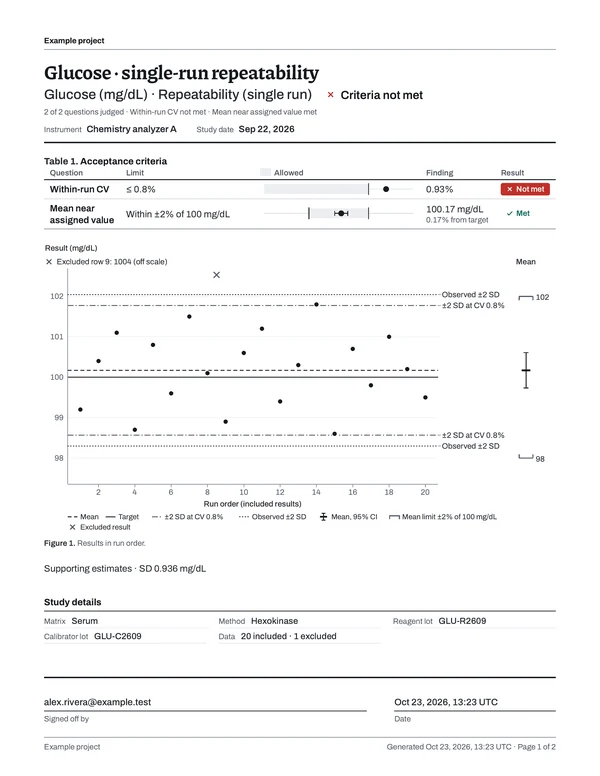
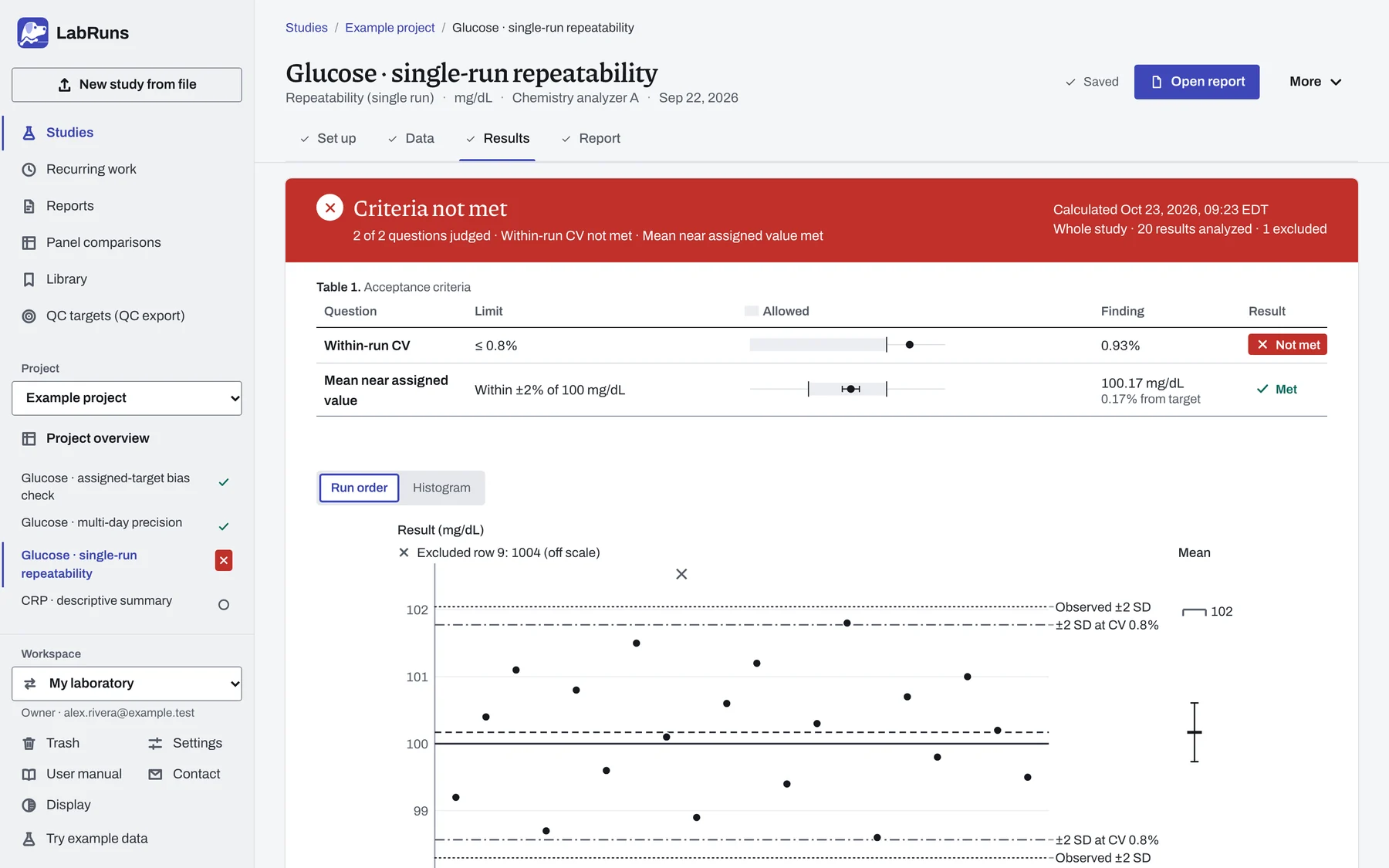
Every limit and its result on one screen.
The CV and the mean are judged against your limits, and every result is plotted in run order with the excluded entry marked, so you see exactly what the calculation used.
Collection plan
- Two stable materials near relevant low and high decision concentrations.
- Enough of each material, stable for the whole collection period.
- Routine operating conditions with acceptable QC on every day.
| Study | Suggested design | Results |
|---|---|---|
| Repeatability | 2 materials × 20 measurements, in one run on one day | 40 results (20 per level) |
| Multi-day precision, short study | 5 days × 1 run per day × 5 replicates, per level | 25 results per level, 50 for two levels |
| Multi-day precision, separate run and day effects | 20 days × 2 runs per day × 2 replicates, per level | 80 results per level, 160 for two levels |
Add levels for other clinical decision concentrations. This plan follows the single-run design in Chesher's 2008 review of assay precision. One run a day combines run and day effects. Plan more runs a day to separate them. The short study follows the CLSI EP15-A3 (2014) design in CLSI's public precision implementation guide.
Acceptance limits
Set an SD or CV limit for each level, for repeatability or, in a multi-day study, for within-laboratory precision. An SD limit can combine a fixed amount in the study unit with a percentage of the level mean.
To check a manufacturer's claim, enter its concentration and SD or CV. LabRuns compares your result with a one-sided verification limit calculated from the claim, at 95% confidence unless you change it, and reports Consistent with the claim or Higher than the claim. Your laboratory's limits get a separate outcome alongside it.
Report
For each level, the report gives the mean with its confidence interval and the SD and CV against your limits, with every result plotted in run order. A multi-day report also counts the days, runs and replicates it found and splits the imprecision into the within-run, between-run and between-day SDs behind the within-laboratory figure. If you entered a manufacturer's claim, a claim table lists the claimed SD, the verification limit and the outcome for each level.
Records
Each saved calculation keeps the data and limits it used. History lists every saved calculation and signed report, each with its own PDF. Prepare an evidence binder with the report versions you choose, grouped by analyte or analyzer, and download the combined PDF and supporting archive.
Guides
Read the bench guide before you collect, or follow an example study from setup to its signed report.
Run your next precision verification.
Start from the suggested collection plan, bring in your analyzer results and sign the report once your laboratory has made its decision.
For a single run, start a repeatability study.