

Comparison and bias
Reagent lot verification
Check a new reagent or calibrator lot, or another shipment of the current lot, before patient testing. Run the same patient specimens on the current lot and the new one. LabRuns checks each paired difference against your allowable error and reports the shift in each concentration group.
Your first week is free, with no card needed. See pricing.
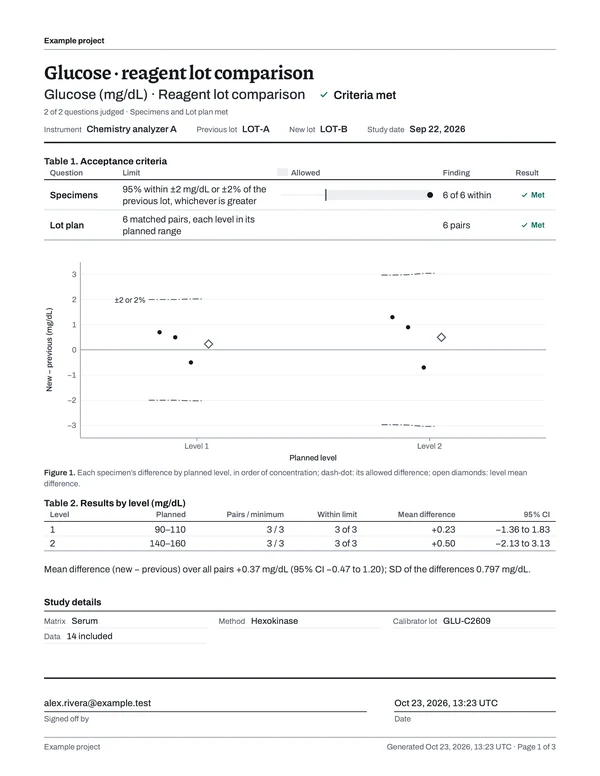
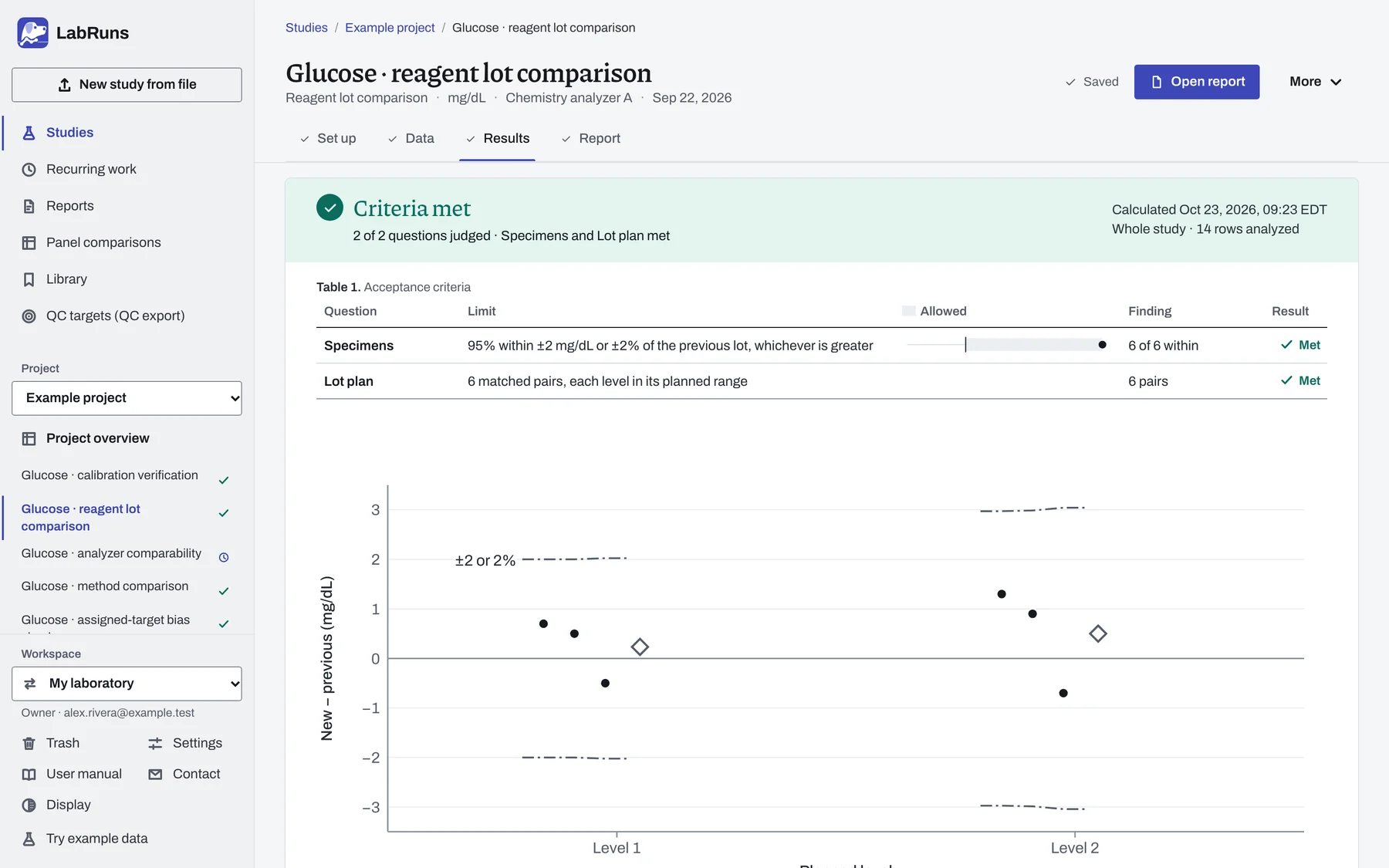
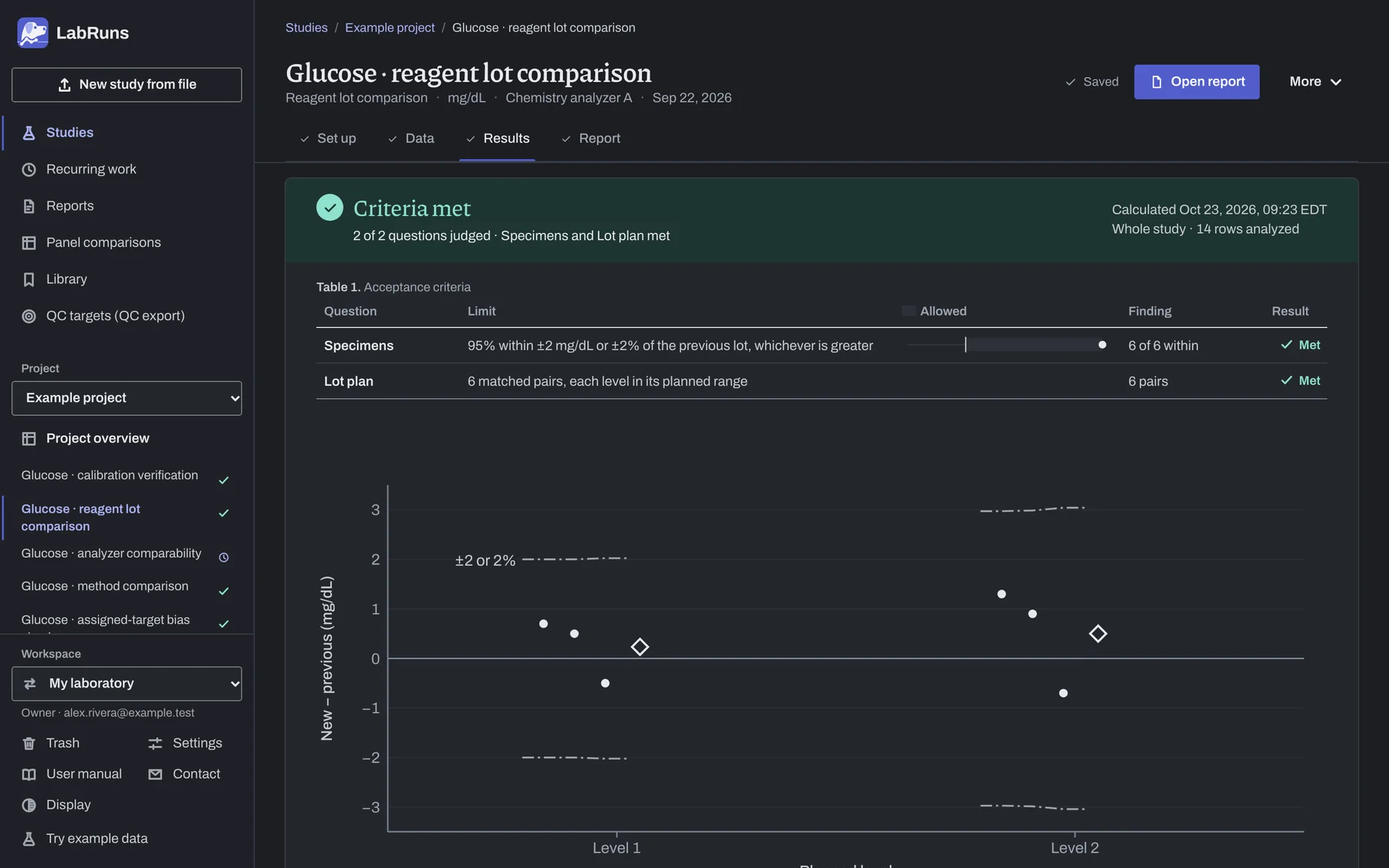
Every limit and its result on one screen.
The specimen rule, the count within limits and the lot plan sit at the top, with the new lot plotted against the previous one and each difference drawn inside its allowed range.
Collection plan
- Independent patient specimens in every important concentration group.
- Both lots, with appropriate calibration and QC. Measure within the specimens' stability window.
- Optional QC results, alongside the patient specimens.
Suggested starting design: 3 concentration groups × 20 specimens, each measured once on both lots; 60 specimens, 120 results.
Choose enough independent specimens to cover each important concentration group and the method's variability. For example, with a paired-difference SD of 2 units, 20 specimens per group give a 95% interval of about ±0.94 units around the mean difference. Calculated with the NIST mean-interval formula.
Every new study starts from this plan. Adjust the concentration groups and the number of pairs to suit your test, then save it as your lot plan for later deliveries.
Acceptance limits
Set the allowable error for each specimen as an amount in the study unit, a percentage of the previous-lot result, or both, with different limits by concentration if you need them. Pick one of the sourced proficiency-testing limits for the analyte where there is one, or type your own.
The lot passes when the lot plan is complete and at least 95% of specimens are within their limit. With fewer than 20 specimens, every one has to be within it, and ticking Every specimen must be within its limit holds a larger study to the same standard.
Report
Page 1 plots each specimen's new-lot result against its previous-lot result, and each difference against its allowed range. With more than one concentration group, a table gives each group's pairs, how many are within their limits and the mean difference with its 95% confidence interval, followed by the overall shift and the acceptance criteria. Later pages list every matched specimen on both lots with its difference, allowance and outcome, and the QC results on both lots. Differences are new lot minus previous lot, so a positive difference means the new lot reads higher.
Records
Each saved calculation keeps the data and limits it used. History lists every saved calculation and signed report, each with its own PDF. Prepare an evidence binder with the report versions you choose, grouped by analyte or analyzer, and download the combined PDF and supporting archive.
In Recurring work, every new lot or shipment is its own event, including a new shipment of the same lot, and Create next study copies the design and limits for the next delivery.
Guides
Read the bench guide before you collect, or follow an example study from setup to its signed report.
Run your next reagent lot verification.
Start from the suggested collection plan, bring in your analyzer results and sign the report once your laboratory has made its decision.