


Carryover reference
Carryover compares low results that follow a high with low results that follow a low, in the fixed 21-position sequence, and decides each run against an error limit.
Settings
Section titled “Settings”| Setting | Where | What it does |
|---|---|---|
| Error-limit basis | Carryover · 21-position sequence | 3 × SD of low-after-low results (the default), User-defined in the study unit, or Percentage of Low-Low mean |
| Error limit | Carryover · 21-position sequence | Required for a user-defined or percentage basis before calculating |
Each run measures one low and one high material at positions 1 to 21 in the order L L L H H L H H L L L L H H L H H L H H L. The experimental unit is the run.
| Positions | Group | Used for |
|---|---|---|
| 1 | Initial low | Record only |
| 2, 3, 10, 11, 12 | LL · low after low | LL mean and LL SD |
| 6, 9, 15, 18, 21 | HL · low after high | HL mean |
| 4, 5, 7, 8, 13, 14, 16, 17, 19, 20 | High | Checking the high material is higher |
Start a blank 21-position run or Append a blank 21-position run on Data adds 21 rows with the next run ID, positions, roles and the material IDs Low and High.
Columns
Section titled “Columns”| Column use | Grid column | Required | What to enter |
|---|---|---|---|
| Run | Run | Yes | One ID for all 21 results of one run, for example R1. Each run gets its own decision |
| Position in the run | Sequence position | Yes | Whole number 1 to 21, used once in each run. This column sets the order, whatever the row order |
| Sample role | Role | Yes | high or low (H and L accepted), any case |
| Specimen or material ID | Material ID | No | One ID for the low and a different one for the high, in each run |
| Result | Result | Yes | A number. Qualified results such as <5 can't be used |
The calculation stops if a row is marked, for example a blank result or two rows in a run sharing a position.
A run is calculated but Undecided when:
- a position is missing, excluded or outside 1–21
- a role doesn't match the sequence
- the low and high material IDs conflict within the run
- the limit is 3 × SD and all five LL results are identical, so the SD is zero
- the high-material mean is not above the low-material mean
Acceptance limits
Section titled “Acceptance limits”The error limit is the only acceptance rule. Each run is judged by one limit, Carryover below error limit, shown as Met, Not met or Undecided in the acceptance table.
- Carryover must be strictly below the limit: a carryover equal to the limit is Not met.
- Any run that is not met gives Criteria not met. Otherwise, any undecided run gives Undecided.
- When the LL SD is zero, an absolute or percentage limit can still decide.
- A percentage limit uses the Low-Low mean as its baseline and needs that mean above zero. For example, LL mean 25 mg/dL and a 4% limit give a 1 mg/dL limit; carryover of exactly 1 mg/dL fails the strict rule.
- A negative carryover (lows after highs read lower on average) is below any positive limit and passes. A note points it out, because the check looks for an increase only.
See About acceptance decisions.
Results and plots
Section titled “Results and plots”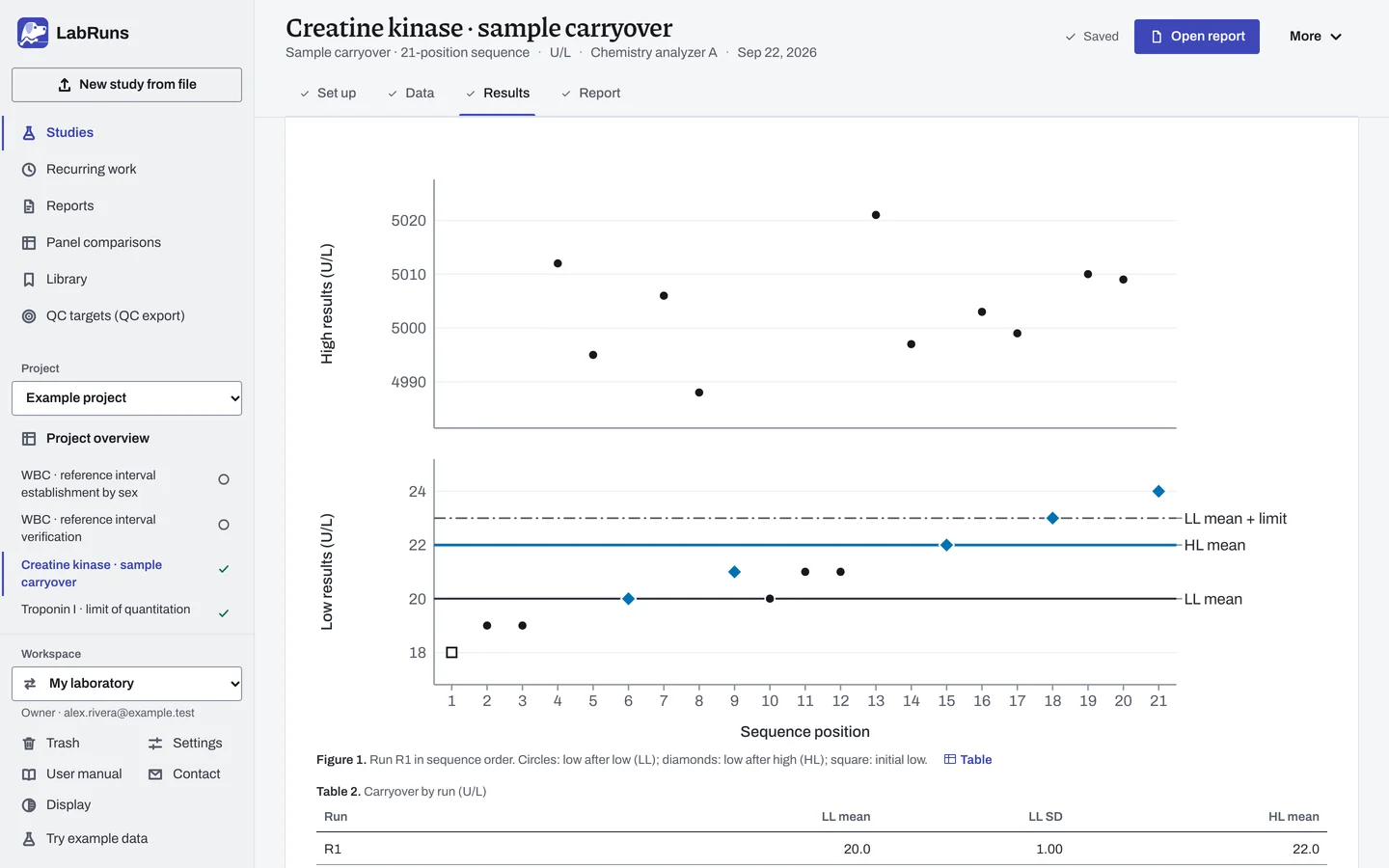
Run details picks the run.
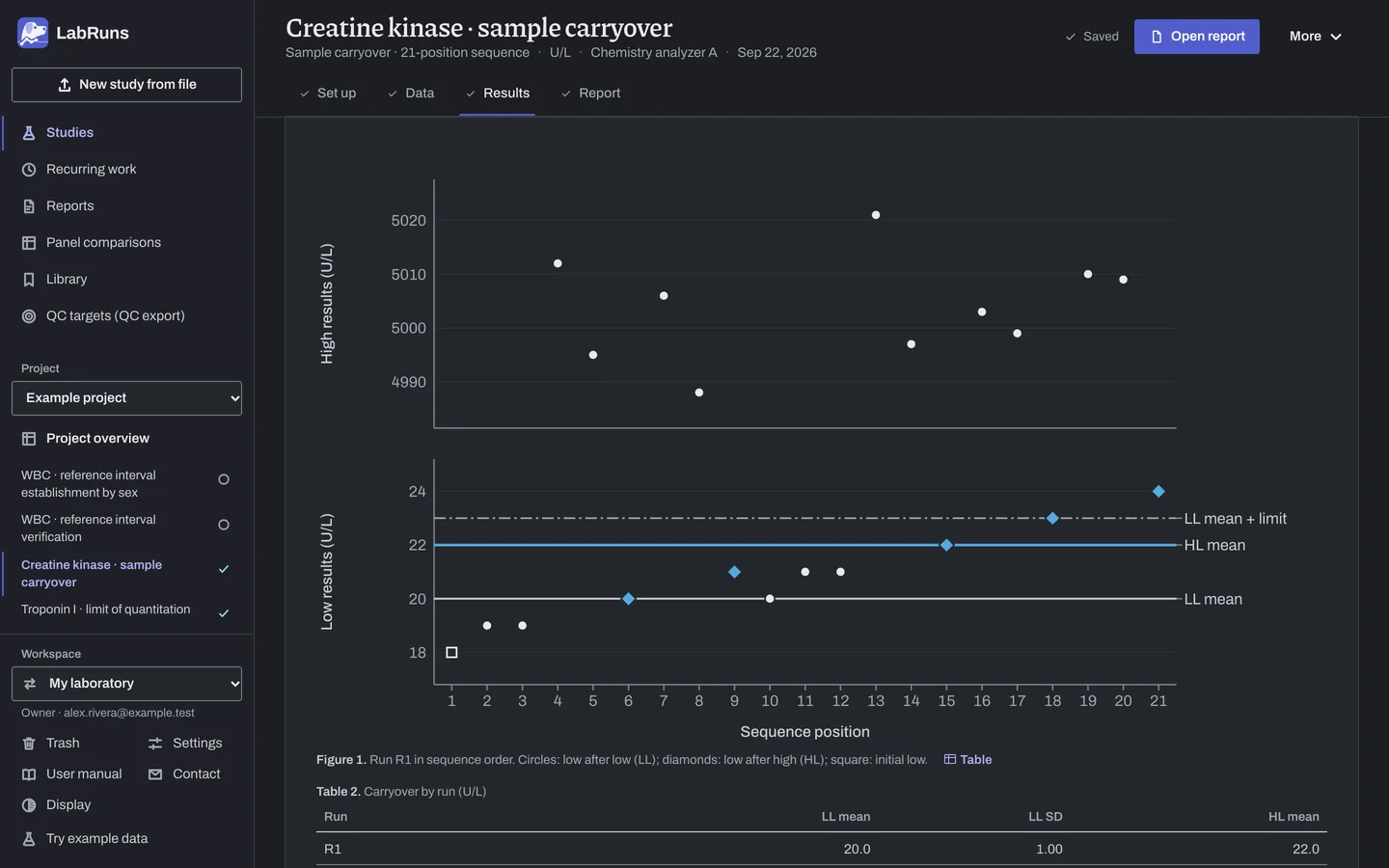
The plot shows the run in sequence order: high results in the top panel and low results below, at positions 1–21. LL points are circles, HL points diamonds and the initial low a square. Lines mark the LL and HL means, and a dashed line marks the LL mean plus the error limit, which the HL mean must stay below. HL diamonds above the LL line, or a trend along the run, show in this plot.
Carryover by run gives each run's LL mean, LL SD, HL mean, HL − LL, error limit and decision, with the reason for an undecided run. The acceptance table below it states the limit and how many runs are below it. Detailed statistics adds the LL and HL n, mean and SD.
Run … · results in measurement order lists all 21 rows in position order, each linked to its row on Data. An excluded result is marked ×.
Example
Section titled “Example”carryover.csv: one example run R1, creatine kinase in U/L, low material LOW-01 (18 to 24 U/L) and high material HIGH-01 (4988 to 5021 U/L). Setup: 3 × SD of low-after-low results.
| Value | Result |
|---|---|
| LL · low after low: n, mean, SD | 5, 20.0 U/L, 1.00 U/L |
| HL · low after high: n, mean, SD | 5, 22.0 U/L, 1.58 U/L |
| Carryover effect · HL − LL | +2.0 U/L |
| Error limit (3 × LL SD) | 3.0 U/L |
| Carryover below error limit | Met (+2.0 U/L against a limit of < 3 U/L). Study: Criteria met |
LL results (positions 2, 3, 10, 11, 12) are 19, 19, 20, 21, 21 U/L. HL results (6, 9, 15, 18, 21) are 20, 21, 22, 23, 24 U/L.
| Setting | Carryover; limit | Outcome |
|---|---|---|
| User-defined limit 2 U/L | +2.0 U/L; < 2 U/L | Not met: carryover equals the limit. Study: Criteria not met |
| User-defined limit 5 U/L | +2.0 U/L; < 5 U/L | Met. Study: Criteria met |
Calculations and sources
Section titled “Calculations and sources”When you calculate Creatine kinase · sample carryover in the example project, LabRuns records these methods:
- 21-position specimen carryover in the sequence L1 L2 L3 H1 H2 L4 H3 H4 L5 L6 L7 L8 H5 H6 L9 H7 H8 L10 H9 H10 L11. Each run is analyzed separately.
- Low-Low results are positions 2, 3, 10, 11 and 12. High-Low results are positions 6, 9, 15, 18 and 21. Carryover = mean(High-Low) − mean(Low-Low), in the study unit, with its sign.
- The default error limit is 3 × the sample SD of the five Low-Low results. You can instead set an absolute limit or a percentage of the positive Low-Low mean. The percentage limit is percentage × Low-Low mean / 100, in the study unit. Following pSMILE, carryover must be strictly below the limit.
- Each run needs all 21 positions with the listed roles, and the same two materials in one uninterrupted run with no other samples in between. The high-material mean must be above the mean of all low results. An incomplete run can’t pass.
- With a Low-Low SD of zero, an absolute or percentage limit can give a decision.
Decisions use full-precision values. A carryover and limit that look equal on screen can still differ, in either direction; a note says which side the exact carryover is on. With the SD limit, the test is Carryover² < 9 × LL variance for a positive carryover.
Sources: pSMILE Carryover Guidelines VAL 2015 v1.1, reviewed 2025 (strict less-than rule with 3 × LL SD). See Study reference.
Evidence references: CAP COM.40350 (9 December 2025). In a binder, the CAP evidence index lists the report sections behind each requirement and the laboratory records that go with them.