


Measurement uncertainty reference
A measurement uncertainty study estimates combined and expanded measurement uncertainty from routine within-laboratory precision and assigned-value bias evidence for a stated range. It reports the precision, bias and assigned-value components, the combined standard uncertainty and the expanded uncertainty at the chosen coverage factor.
Settings
Section titled “Settings”| Setting | Meaning |
|---|---|
| Bias evidence | Multiple assigned materials or events, or One assigned material across independent runs |
| Calculation unit | Absolute, in the study unit, or Percentage. Changing it clears the within-laboratory SD or CV and the expanded-uncertainty limit, which are in the old unit, so you enter or copy them again |
| Within-laboratory SD or Within-laboratory CV | Required. The SD in an absolute calculation, the CV in a percentage one |
| Saved within-laboratory precision | A saved estimate to copy with Copy precision. The copied value keeps its source calculation and concentration; editing the precision value, concentration or calculation unit clears the link |
| Applicable range | Defaults to the lowest and highest assigned values when left blank |
| Representative concentration | Defaults to the mean of the assigned values. A copied precision estimate fills in its concentration |
| Coverage factor | Initially 2 |
| Expanded-uncertainty limit | Optional, in the calculation unit |
Columns
Section titled “Columns”| Column | Required? | What to enter |
|---|---|---|
| Material / event ID | Yes | The assigned material or proficiency event |
| Laboratory result (Run mean for one material) | Yes | The laboratory's result, or one material's mean of one independent run |
| Replicate (Run ID for one material) | No | Labels each independent run for one material |
| Assigned value | Yes | The material's or event's assigned value |
| Assigned uncertainty | Yes | The assigned value's stated uncertainty |
| Assigned coverage factor | Yes | The coverage factor of that uncertainty. A row added by hand starts at 1; change it to the stated factor for an expanded uncertainty |
Laboratory results, assigned values and assigned uncertainties use the study's measurement unit, even for percentage calculations. The coverage factor has no unit; a factor of 1 means the assigned uncertainty is already a standard uncertainty.
For multiple materials, repeated measurements use the same ID and are averaged. A new assigned value or uncertainty needs a distinct material or event ID. For one material, every row has the same material ID and its own Run ID.
Acceptance limits
Section titled “Acceptance limits”The optional expanded-uncertainty limit is in the calculation unit and includes equality. Without it, the workup is descriptive.
Results and plots
Section titled “Results and plots”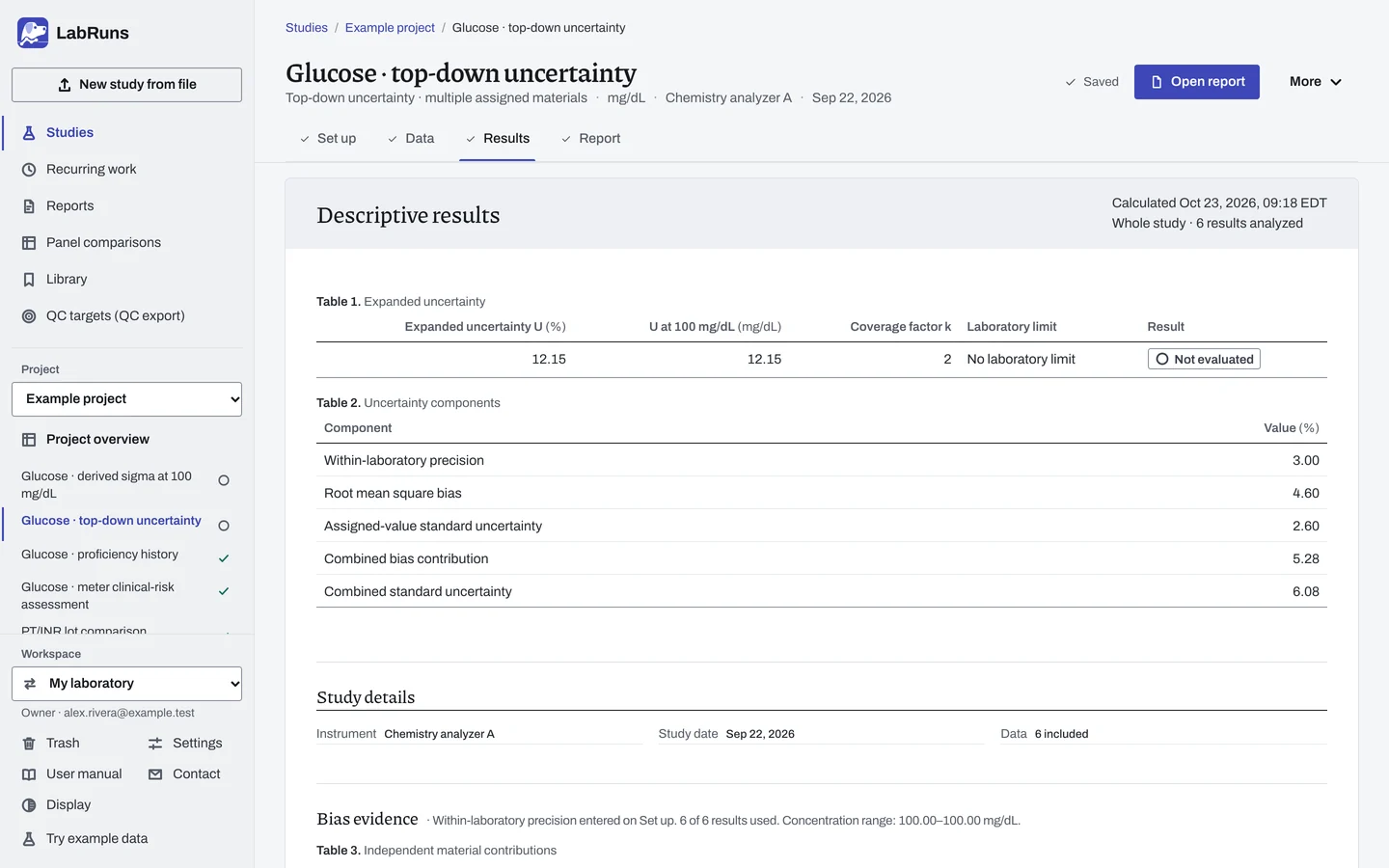
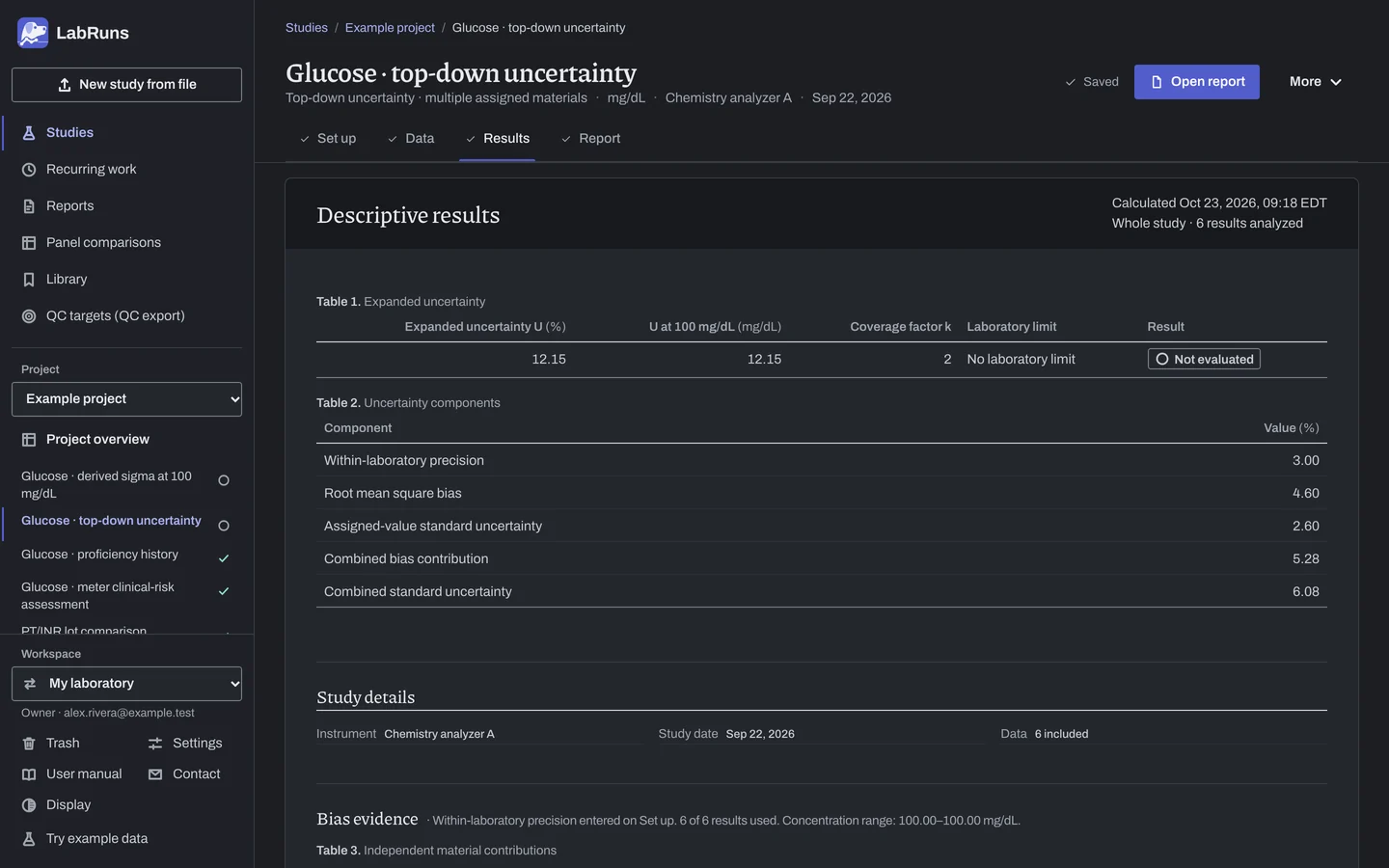
Results give the precision source, input units, material or run counts, stated range and coverage factor, and each uncertainty component separately with the combined and expanded uncertainty. Uncertainty of the mean bias appears for one material measured across independent runs. Expanded uncertainty also gives U in the other unit at the representative concentration, for example U at 100 mg/dL. A changed copied precision source is reported as a finding.
Example
Section titled “Example”The uncertainty example represents six proficiency events at an assigned value of 100 mg/dL. With within-laboratory CV 3%, it gives RMS bias 4.60%, assigned-value standard uncertainty 2.60%, combined standard uncertainty 6.08% and expanded uncertainty 12.15% at a coverage factor of 2.
Calculations and sources
Section titled “Calculations and sources”When you calculate Glucose · top-down uncertainty in the example project, LabRuns records these methods:
- Top-down measurement uncertainty uses the stated within-laboratory SD or CV as u(Rw). It must represent routine intermediate precision for the stated measurement range.
- Each assigned-value uncertainty is divided by its stated coverage factor; a factor of 1 identifies standard uncertainty. Group SD is not substituted for assigned-value uncertainty.
- With multiple materials or events, repeat results are averaged per material. RMS bias = square root of the mean squared material biases. The assigned-value component is the arithmetic mean of the material standard assigned uncertainties. u(bias)² = RMS bias² + mean u(reference)².
- Combined standard uncertainty = square root of [u(Rw)² + u(bias)²]. Expanded uncertainty = coverage factor × combined standard uncertainty. A stated factor of 2 is the approximate 95% coverage convention; the effective degrees of freedom are left unestimated.
- Absolute calculations use the study unit. Percentage calculations divide each material bias and standard assigned uncertainty by that material’s assigned value and multiply by 100; the precision input is CV%.
- The applicable range is entered by the laboratory or defaults to the span of assigned values. A displayed absolute or percentage equivalent uses the stated concentration or mean assigned value.
- A selected expanded-uncertainty limit uses the exact rational squared components and includes equality. A changed copied precision source cannot produce a met verdict until refreshed.
With one material, the bias component also includes the sample variance of independent run means divided by the number of runs.
The component model follows Nordtest TR 537, edition 4 (2017), sections 3 and 6. Independent evidence checks its six-event component example, a single-material calculation and exact expanded-limit equality. See Calculation checks.